

By Peter C. Dorsey, Jr., President of The Business Development Company of Rhode Island, which has lent to Rhode Island businesses since 1953.
A second lender can fill the gap when a bank funds only part of what an established company needs. The Business Development Company provides loans of $50,000 to $750,000 that sit behind the bank’s loan, so the company can obtain the additional capital while maintaining its bank relationship. In one case, the president of a distributor owned 25% of the company and wanted to buy the 75% held by the retiring founder. The senior bank could not finance the entire purchase price, and a $600,000 mezzanine term loan closed the gap.
Who finances a company when the bank will not lend the full amount?
Three options cover most situations.
| Option | How it works | When it fits |
|---|---|---|
| A second lender behind your bank (Junior or Mezzanine Debt) | The loan sits in a junior collateral position behind the bank’s loan. Loans run $50,000 to $750,000, with larger amounts through syndication. | The company wants to keep its primary banking relationship. |
| An SBA 7(a) or SBA Express loan | A bank or secondary lender makes an SBA-backed loan. | The loan must meet SBA program terms on the use of proceeds, and collateral subordination. |
| Business owner contributes additional capital | The owner contributes additional funds in the form of equity or junior debt. | Funds are available personally or from investors on favorable terms. |
The Business Development Company is an approved lender for both SBA 7(a) and SBA Express loans, so an SBA-backed loan can be an option depending upon the circumstances.
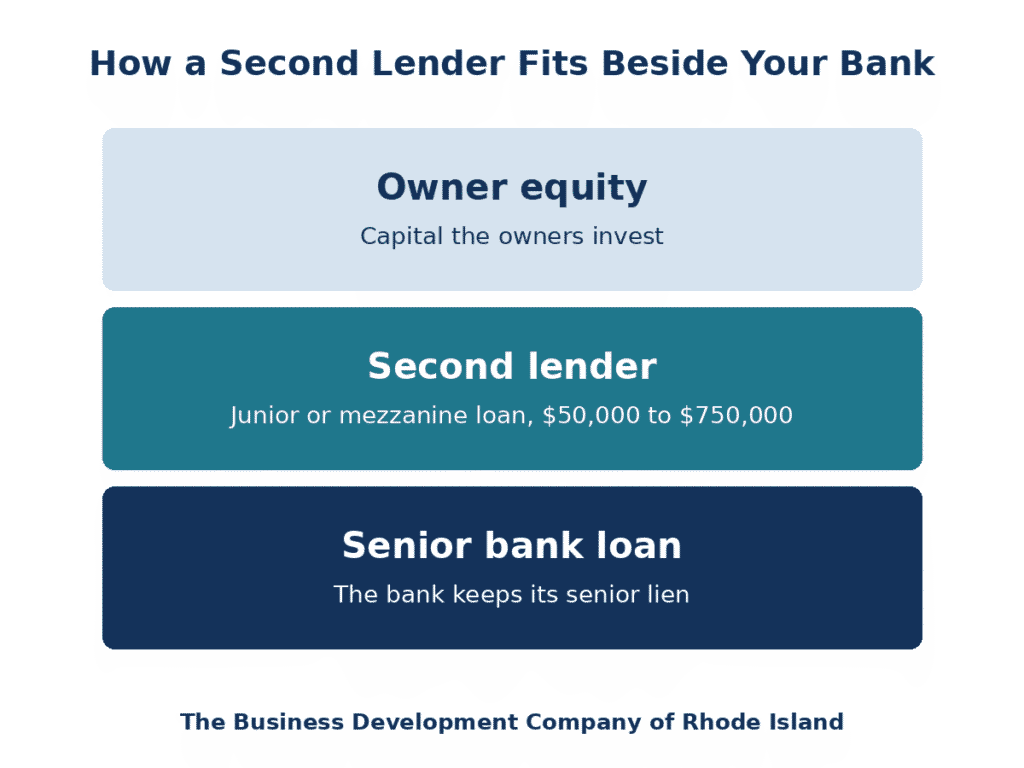
How does a second lender work with your bank?
The Business Development Company has a history of partnering with local banks and credit unions, and the first step would be meeting with you and your bank to get on the same page about the loan’s purpose and an acceptable structure. An Intercreditor Agreement typically confirms the bank retains a senior lien on the company’s assets and determines the two lenders’ rights while the bank’s loan is outstanding. In order to make the capital structure as seamless as possible, our financial reporting requirements and loan covenants mirror the bank.
If a company cannot obtain bank financing, The Business Development Company can serve as a company’s primary lender. Our Types of Funding page lists each loan type, and our Case Studies show how other companies have used them.
What can a second lender finance?
We customize each loan because every company is unique, and when the business plan shows a loan request supporting a good business decision, we can finance just about anything. Loan proceeds can fund equipment, leaseholds, acquisitions, refinancing, research and development, and working capital. We also lend against accounts receivable, inventory, and purchase orders.
What does a second lender cost, and how long does it take?
Loan pricing reflects the risk the lender takes and is set deal by deal. Interest rates can be fixed or variable and are slightly higher than a bank. Subordinated loans from The Business Development Company in 2026 have ranged from 7 to 9 percent, and application and underwriting fees are commonly 1 percent of the loan amount. Legal fees vary with the loan structure and the company’s status.
If a loan applicant’s financial information appears to be a possible fit, we follow up with an in-person meeting. If that produces mutual interest, we provide a term sheet. From there a formal loan approval can take 30 to 60 days. Our Screening Process page walks through the steps.
Who fits today, and when should you come back?
The Business Development Company weighs the full picture of each company when it makes a loan decision. We typically work with business owners of established companies who can demonstrate a thoughtful business plan and provide timely, accurate financial statements. An early stage company potentially becomes eligible when it has passed the recurring revenue benchmark.
Five key criteria:
- Recurring revenues show the company has established a market presence.
- A business plan shows how the funds will be used to promote further success.
- Current financial statements are ready to share.
- If a bank is involved, its level of support has been defined. If not, The Business Development Company would consider being the primary lender.
- The need falls between $50,000 and $750,000, or is larger and suited to syndication.
Our FAQs answer the most common questions, and you can meet the lending team on our Our Team page. The next step is to complete our online application, and our lending team will follow up with you.